Did NASA Fake It? The Truth About the Waving Flag


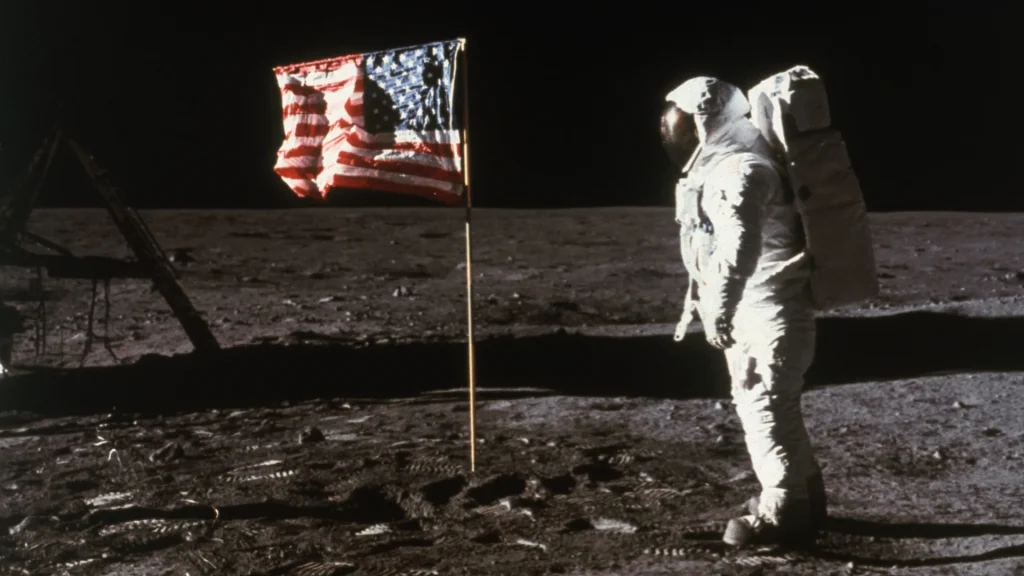
It is one of the most persistent debates in modern history. You have seen the footage: Apollo astronauts planting the American flag on the lunar surface. But wait—is that flag fluttering?
“There is no wind in space!” say the skeptics. “It must be fake!”
While the observation is correct—there is no wind on the Moon—the conclusion is wrong. The physics of space are stranger than they appear on Earth. Today, we are debunking the “waving flag” myth and looking ahead to the Red Planet, where the rules of the game change completely.
The Moon: Why Does the Flag Look Like It’s Waving?

To understand why the Apollo flags look the way they do, we need to understand the environment of the Moon.
1. The Horizontal Rod If you planted a regular flag on the Moon, it would simply hang limp against the pole because there is no air to hold it up. To solve this, NASA engineers designed a telescopic horizontal rod (an L-shaped latch) inserted along the top hem of the flag. This was specifically designed to keep the flag extended so the “Stars and Stripes” would be visible in photographs.
2. The “Ripple” Effect (Inertia) So, why does it look like it is moving in the videos? On Earth, air resistance (drag) stops a moving object quickly. On the Moon, there is a vacuum. There is no air resistance.


When the astronauts were twisting the pole to plant it into the ground, that rotational force traveled through the fabric. Because there is no air to slow down the motion, the flag kept “rippling” from its own momentum for much longer than it would on Earth. It wasn’t waving due to wind; it was waving due to inertia.
Once the astronauts let go, the flag remained completely still, frozen in its crumpled shape.
Mars: A Different Kind of Atmosphere

Now, let’s fast forward to the 2040 vision and our next destination: Mars.
Unlike the Moon, which is a vacuum, Mars does have an atmosphere. It is very thin (about 1% the density of Earth’s) and composed mostly of carbon dioxide, but it is there.
Mars also has weather. It has winds, dust devils, and massive planetary dust storms.
- Will a flag wave on Mars? Yes.
- How? It won’t snap violently like a flag in a hurricane on Earth (unless during a major storm), but a flag planted on Mars would gently undulate in the Martian breeze without the need for a horizontal rod to hold it open.
The Real Question: Whose Flag Will It Be?
We know the physics. We know that the Moon flags are static monuments to history, and Martian flags will be dynamic markers of a new civilization.
The science is settled. The only question remaining for the future of humanity is not if a flag will wave on Mars, but whose flag it will be.
Will it be a national flag like the USA or China? Or, in the era of Human 2.0 and private space exploration, will we see the logo of SpaceX waving in the red dust?
The race to plant that flag is already on.
You Might Also Like;